Understanding Ethernet: The Backbone of Modern Networking


The Origins and Evolution of Ethernet Technology
Ethernet was invented in 1973 at Xerox PARC by Robert Metcalfe, who envisioned a system to connect computers within a local area. The first experimental Ethernet operated at 2.94 Mbps over coaxial cable. In 1980, Digital Equipment Corporation, Intel, and Xerox standardized Ethernet as “DIX Ethernet,” supporting 10 Mbps. The IEEE 802.3 committee formalized these standards in 1983, creating the foundation for all subsequent iterations. Since then, Ethernet has evolved from thick coaxial cabling (10BASE5) through thin coaxial (10BASE2), twisted-pair (10BASE-T), and fiber optics (10BASE-F). Modern Ethernet now supports speeds ranging from 100 Mbps (Fast Ethernet) to 400 Gbps, with 800 Gbps and 1.6 Tbps under development. This relentless progression has made Ethernet the dominant wired networking technology globally, connecting over 10 billion devices as of 2024.
How Ethernet Functions: The Core Mechanism
Ethernet transmits data in discrete units called frames. Each frame consists of a preamble (7 bytes for synchronization), a Start Frame Delimiter (1 byte), destination and source MAC addresses (6 bytes each), an EtherType field (2 bytes indicating the upper-layer protocol, such as IPv4 or IPv6), payload data (46 to 1500 bytes, extendable to 9000 bytes for jumbo frames), and a Frame Check Sequence (4 bytes for error detection). Ethernet operates at Layer 2 (Data Link Layer) of the OSI model. It uses Carrier Sense Multiple Access with Collision Detection (CSMA/CD) in half-duplex mode—listening before transmitting and retrying after collisions. Full-duplex Ethernet, enabled by switches, eliminates collisions by using separate transmit and receive channels, allowing simultaneous bidirectional communication.
Key Components of an Ethernet Network
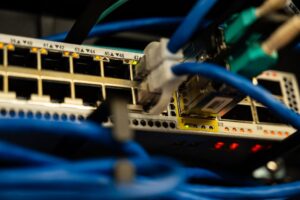
The fundamental building blocks of Ethernet networks include Network Interface Cards (NICs), cables, switches, routers, and repeaters. NICs implement the Ethernet protocol on end devices, each assigned a unique 48-bit MAC address by manufacturers. Twisted-pair copper cables (Cat5e, Cat6, Cat6a, Cat7, Cat8) remain the most common physical medium, with Cat6a supporting 10 Gbps up to 100 meters. Fiber optic cables (single-mode and multi-mode) provide longer distances and higher bandwidth, with single-mode fiber supporting 100 Gbps over 40 kilometers. Switches are the central intelligent devices that forward frames based on MAC addresses, maintaining MAC address tables to learn which devices reside on which ports. Routers connect different networks, performing Layer 3 routing using IP addresses. Power over Ethernet (PoE) technology, standardized as IEEE 802.3af (15.4W), 802.3at (30W), and 802.3bt (90W), delivers electrical power alongside data over copper cables, simplifying deployments of IP cameras, VoIP phones, and access points.
Ethernet Speeds and Standards: A Comprehensive Overview
The IEEE 802.3 family defines a hierarchy of Ethernet speeds. 10BASE-T (10 Mbps) and 100BASE-TX (100 Mbps) use two twisted pairs in Cat5 cable. 1000BASE-T (Gigabit Ethernet) uses all four pairs in Cat5e or better, achieving 1 Gbps. 10GBASE-T (10 Gigabit) requires Cat6a or Cat7 and operates up to 100 meters. 40GBASE-T and 25GBASE-T emerged for data centers, with 40GBASE-T using Cat8 cable. Fiber variants include 10GBASE-SR (300 meters over multi-mode), 10GBASE-LR (10 km over single-mode), and 40GBASE-SR4 (100 meters over parallel multi-mode). Higher speeds like 100GBASE-LR4 (10 km) and 400GBASE-DR4 (500 meters) leverage wavelength division multiplexing. The IEEE P802.3df Task Force is standardizing 800 Gbps and 1.6 Tbps Ethernet, expected by 2025, using 112 Gbps and 224 Gbps serial signaling.
The Role of Switching in Ethernet Efficiency
Switches revolutionized Ethernet by replacing hubs, which broadcast all data to every port. Managed switches offer VLANs (IEEE 802.1Q), spanning tree protocol (STP) for loop prevention, link aggregation (LACP, IEEE 802.3ad), and Quality of Service (QoS) prioritization. VLANs segment a physical network into multiple logical networks, enhancing security and reducing broadcast traffic. Spanning Tree Protocol (IEEE 802.1D) and its faster successor Rapid Spanning Tree Protocol (RSTP, IEEE 802.1w) prevent network loops by blocking redundant links until needed. Link Aggregation Control Protocol combines multiple physical links into a single logical link, increasing throughput and providing redundancy. Cut-through switching forwards frames as soon as the destination address is read, reducing latency to microseconds, while store-and-forward switching checks the entire frame for errors before forwarding.
Ethernet Cabling: Types, Limitations, and Best Practices
Copper cabling remains predominant for short-range connections. Cat5e supports 1 Gbps to 100 meters, Cat6 supports 5 Gbps to 100 meters but 10 Gbps to 55 meters, and Cat6a supports 10 Gbps to 100 meters. Cat7 operates at 10 Gbps to 100 meters with shielded connectors (GG45 or TERA). Cat8 supports 25-40 Gbps to 30 meters, designed for data center rack connections. Fiber optic cabling uses light pulses, immune to electromagnetic interference. Multi-mode fiber (OM3, OM4, OM5) with 850 nm lasers supports 10 Gbps to 300-550 meters. Single-mode fiber (OS2) with 1310 nm or 1550 nm lasers supports 10 Gbps to 40 km or more. Best practices include using solid-core cable for in-wall installation and stranded patch cables for flexibility; avoiding running parallel to electrical cables; maintaining bend radius of four times the cable diameter; and testing certification to ensure signal-to-noise ratios and return loss parameters.
Ethernet and the OSI Model: Layer 2 Operations
Ethernet primarily functions at Layer 2, providing reliable data framing, error detection, and Media Access Control (MAC). The Logical Link Control (LLC) sublayer (IEEE 802.2) manages multiplexing between different network protocols, while the MAC sublayer handles frame addressing and collision management. Each Ethernet frame carries source and destination MAC addresses, which are used by switches to populate forwarding tables. The Address Resolution Protocol (ARP) maps IP addresses to MAC addresses within a broadcast domain. Ethernet frames also support a Quality of Service priority field (802.1p) within VLAN tags, enabling traffic prioritization for voice and video. The maximum transmission unit (MTU) for standard Ethernet is 1500 bytes; jumbo frames extend this to 9000 bytes, reducing overhead for large data transfers in storage networks.
Real-World Applications of Ethernet Technology
Ethernet powers enterprise local area networks (LANs), connecting desktops, servers, printers, and Wi-Fi access points. Data centers use high-density 25/40/100/400 Gbps Ethernet for server-to-switch and switch-to-switch links. Industrial Ethernet, governed by standards like EtherNet/IP, PROFINET, and Modbus TCP, supports factory automation with deterministic timing and ruggedized connectors (M12, M8). Carrier Ethernet (MEF-defined) provides metropolitan and wide area network services with strict service level agreements (SLAs) on bandwidth, latency, and jitter. Automotive Ethernet (IEEE 802.3bw, 802.3ch) operates over single twisted pair at 100 Mbps to 10 Gbps for advanced driver-assistance systems (ADAS) and infotainment. Home networks rely on Gigabit Ethernet for streaming 4K video, online gaming, and smart home devices. Internet of Things (IoT) deployments increasingly use Power over Ethernet (PoE) to simplify sensor and actuator installations.
Security Considerations in Ethernet Networks
Ethernet security encompasses physical, data link, and higher-layer measures. Physical security involves securing switch cabinets, disabling unused ports, and using MAC address filtering. Port security limits the number of MAC addresses per switch port, preventing CAM table overflow attacks. DHCP snooping filters untrusted DHCP server responses, protecting against rogue DHCP attacks. Dynamic ARP Inspection (DAI) validates ARP packets, preventing man-in-the-middle intercepts. IEEE 802.1X provides port-based network access control, requiring authentication before granting network access. VLAN segregation isolates sensitive traffic, and private VLANs restrict communication within a VLAN to designated uplinks. Network segmentation using firewalls and routers complements Ethernet-level controls. Encryption protocols such as MACsec (IEEE 802.1AE) encrypt data at Layer 2, protecting against physical layer eavesdropping.
Troubleshooting Common Ethernet Issues
Common Ethernet problems include link drops, speed mismatches, and excessive collisions or CRC errors. Diagnostic tools include cable testers (certifying wiremap, length, and impedance), time-domain reflectometers (TDR) for locating breaks, and network analyzers like Wireshark for frame-level inspection. Link light indicators on NICs and switches provide immediate status: solid green indicates link, blinking indicates activity, and amber often indicates errors or slower speed. Speed and duplex mismatches, historically common when connecting a 100 Mbps half-duplex device to a Gigabit full-duplex switch, now auto-negotiate via FLP bursts. Excessive CRC or FCS errors suggest damaged cables or electrical interference. Late collisions indicate over-distance cable runs or signal timing issues. For copper, replacing patch cables and re-terminating jacks often resolves physical layer faults. Fiber issues require cleaning connectors with lint-free wipes and inspecting end-faces with a microscope.
The Future of Ethernet: Emerging Trends and Innovations
Ethernet continues evolving to meet bandwidth demands of artificial intelligence, machine learning, and high-performance computing. The IEEE 802.3dj project targets 200 Gbps per lane, enabling 1.6 Tbps over eight lanes. Energy-Efficient Ethernet (EEE, IEEE 802.3az) reduces power consumption during idle periods by transitioning to low-power idle (LPI) states. Time-Sensitive Networking (TSN, IEEE 802.1Qbv) adds deterministic low-latency capabilities for industrial and automotive use cases. Single Pair Ethernet (SPE, IEEE 802.3cg) operates over one twisted pair, supporting 10 Mbps to 100 meters for IoT and building automation. Ethernet over fiber is extending to 50 km and beyond using advanced modulation formats. The integration of Ethernet with Software-Defined Networking (SDN) allows centralized control of forwarding tables and traffic engineering. These innovations ensure Ethernet remains the universal connectivity fabric for the next decade and beyond.